
Editor in Learning Portal
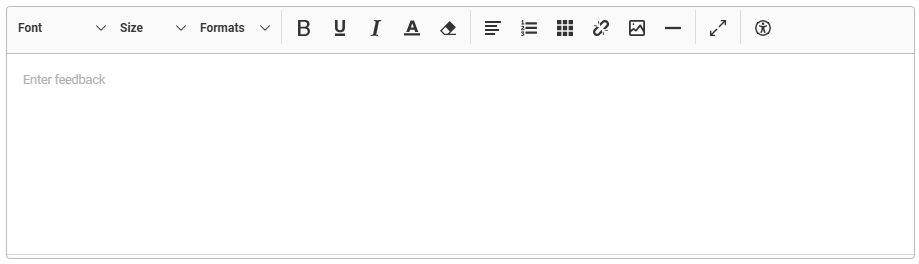
depending on the area available functions may vary.
Overview
The rich text editor provides a modern, unified WYSIWYG (What You See Is What You Get) editing experience across standard learning managers, configuration forms, test authoring, and communication templates. It allows authors and administrators to format text, insert media, embed dynamic placeholders, and maintain accessible, consistent styling throughout the platform.
Key Features & Toolbar Options
The editor provides a comprehensive set of formatting tools. Depending on the specific area and context, available toolbar functions may vary.
Typography & Text Formatting
-
Font Family: Standard web-safe and system-supported fonts (e.g., Roboto, Arial, Helvetica, sans-serif).
-
Font Size: Adjustable font sizing within defined brand and layout styles.
-
Paragraph Styles: Predefined text formats including Paragraph, Heading 1, Heading 2, Heading 3, and block formatting.
-
Character Styling:
-
Bold, Italic, <u>Underline</u>, and Strikethrough.
-
Subscript ($x_2$) and Superscript ($x^2$) (e.g., for test questions and formula notations).
-
-
Color Options: Text font color and background highlight color selection.
-
Remove Format: Cleans formatting from selected text, reverting it to the default style without leaving legacy or broken tags.
Layout & Structure
-
Text Alignment: Left, Center, Right, and Justified text alignment.
-
Lists: Numbered (ordered) and bulleted (unordered) lists, including nested indentations.
-
Tables: Insert and manage responsive grid tables with customizable rows, columns, and headers.
-
Horizontal Line: Insert visual dividing lines to structure content sections.
-
Fullscreen Mode: Expand the editor to full-screen view for focused, distraction-free editing of extensive texts.
Media & Links
-
Hyperlinks: Insert and edit links with customizable display text, web URLs, and target behaviors (e.g., open in a new tab).
-
Images:
-
Upload or link images via URL.
-
Define Alternative Text (Alt text) to support screen readers and web accessibility.
-
Align and arrange inline images seamlessly with text content.
-
-
Rich Media: Embed audio, video, and interactive elements where supported (such as in assessment questions).
Dynamic Placeholders
In communication and template contexts (such as notifications, enrolment message texts, escalation models, and certificate templates), the editor integrates directly with the system Placeholder Tree:
-
Insert dynamic variables (e.g., learner name, course title, enrolment dates, supervisor information) directly into the message body.
-
Placeholders are resolved in real time during email delivery or PDF certificate generation.
Clean Paste & Security
-
Word & External Content Cleaning: Content copied from external sources (such as Microsoft Word or websites) is automatically sanitized on paste, stripping unnecessary markup and inline style conflicts.
-
HTML Sanitization: All rich content is secured against malicious script injection (XSS) while preserving valid HTML structure.
Application Areas in imc Learning Suite
The text editor is standard across key areas of the imc Learning Suite:
|
Area |
Application Contexts |
|---|---|
|
Courses & Learning Paths |
Course descriptions, learning path syllabi, course templates, course sets. |
|
Catalogues & Skills |
Catalogue descriptions, skill scales, competency levels, and skill descriptions. |
|
Communication & Notifications |
Enrolment message texts, user-defined course notifications, HTML mail templates, escalation models, daily reminders, and message monitors. |
|
Certificates |
Learning path and course certificate content, supporting PDF generation with embedded images and placeholders. |
|
Tests & Assessments |
Displayed instructions (Welcome/Goodbye), QTI questions, Cloze tests (fill in the blank), response options, feedback explanations, and learning hints. |
|
Feedback Forms |
Form instructions, question texts, coversheets, and response choices. |
|
Collaboration & Content |
Newsroom articles, forums, default panel contents, and on-the-job training notes. |
|
Resources & Offline Layouts |
Resource scheduling notes and print layout headers/footers. |
Available toolbar options and placeholder trees are automatically tailored to the specific context and permissions of the open manager.