
The "Image section: x of n" test question type marks several areas within a picture as the answer, rather than choosing from a list of text options.
How It Is Built
The "Image section: x of n" type is configured through a tabbed structure covering the question's description, its available languages, the question content and its image, the possible answers, and the areas marked within the image.
Description
Holds the question's basic metadata.
|
Setting |
Description |
|---|---|
|
Name |
The administrative name will be used during the management of the question and when selecting questions during the creation of a test or feedback. It is based on the name shown to the learner when opening the test/feedback. |
|
Description |
The administrative description will be used during the management of the question and when selecting questions during the creation of a test or feedback. It is based on the name shown to the learners when opening the test/feedback. |
|
Keywords |
Search terms associated with the question, used to find it in the question pool. |
|
Test Mode |
The test mode describes the purpose of a test or test question. When adding questions to a test, a targeted search can be carried out with a specific learning test mode. The test mode saved in each test file includes a reference points indicating which questions should be selected. |
|
Average Processing Time (Seconds) |
The completion for test questions are added together and equate to the total completion times for the test containing these test questions. If “No time limit” is selected here, no time will be planned in for the question when adding up. This option should only be selected if, in principle, no completion time controls will be used in tests. When the test is configured to use the timer per test, this value will be used as a countdown on the question itself.
|
|
Level of Educational Objectives |
The level of educational objectives describes the reason why a question has been included in the test. When adding questions to a test, a targeted search can be carried out with a specific level of educational objectives. The level of educational objectives saved in each test file includes a reference points indicating which questions should be selected. |
|
Active |
If disabled, the question which was in its previous version added to a test or feedback, will be removed as part of the automatic update process, if configured to run. |
Manages the languages the question is available in. Each language can be flagged as "Administrative", "Basis", or "Default", and its "Language Translation Status" is tracked (for example "Translated").
Question
Holds the content connected with the question itself, including the shared image the answer areas are marked on, together with the grading configuration.
|
Setting |
Description |
|---|---|
|
Overall Points for the Question |
A single point value awarded for the whole question, used when grading is not split per answer. |
|
Points for Each Possible Answer |
Awards points individually per selected area instead of one overall value. |
|
Allocate 0 Points if All Answers Are Marked |
Explicitly awards zero points when every area is selected, guarding against selecting everything to game the question. |
|
Award 0 Points if No Answer Was Checked |
Explicitly awards zero points when nothing is selected, rather than leaving the outcome undefined. |
|
Image (max. 800 × 500px) |
The image areas are marked by learners in the files uploaded here. |
|
Name |
The displayed name will be managed in several languages and displayed to the learner when they open the question. It is based on the name used for management. |
|
Attachment to Questions |
An optional file uploaded alongside the question. |
|
Question |
The question text as it is presented to the learner. |
|
Instructions for Online Tests |
The text provided here explains to the learner how to process the question if the test is directly accessed in the system, e.g. “Click the box next to the correct answer”. |
|
Instructions for Offline Tests |
The text provided here explains to the learner how to process the question if the test is completed in a printed form, e.g. “Mark the correct answer with an X”. |
|
Response When Answered Correctly |
The text entered here will be displayed to learners after assessing the question if it has been answered correctly. The display of the response depends on the test player’s settings. |
|
Response When Answered Incorrectly |
The text entered here will be displayed to learners after assessing the question if it has been answered incorrectly. The display of the response depends on the test player’s settings. |
Possible Answers
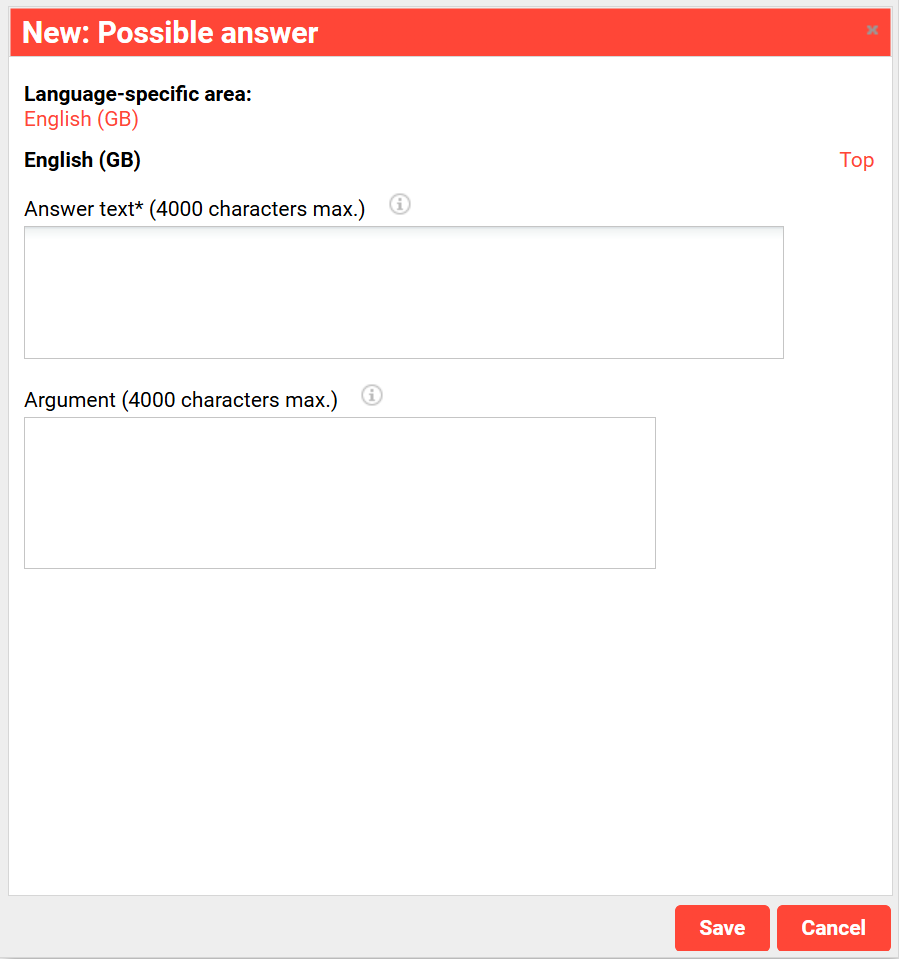
Holds the possible answers for the question; several of them can be the correct solution.
|
Setting |
Description |
|---|---|
|
Answer Text |
The text to be displayed as an answer option for the question is displayed here
|
|
Argument |
The text entered here provides more detailed explanations about the sample solution.
|
Image Sections
Manages the areas within the uploaded image that correspond to each possible answer. This tab requires the image (set on the "Question" tab) and at least one possible answer to exist first.
Classifications
Applies classification categories to the question, supporting its selection and management within the wider test framework.
See Classifications
Arrangement
Positions the answer area to the left of, right of, above, or below the question text.
Creating an Image Area Question
An image is uploaded on the "Question" tab (maximum 800 × 500 pixels), possible answers are created, and the corresponding areas within the image are defined on the "Image Sections" tab.
Scoring
Since multiple areas can be selected, points can be awarded either as a single overall value for the question or individually for each possible answer. Selecting all areas can optionally be configured to award zero points, as can selecting none.
Example
Marking which objects in an image are used for locomotion.