
Impact of the Equivalence Relation Definition
Based on the available equivalence relation rules, the outcome is that courses and course templates will be marked for learners as "Covered".
Impact in the Learning Path
All components that are marked for the learner as "Covered", are displayed accordingly.
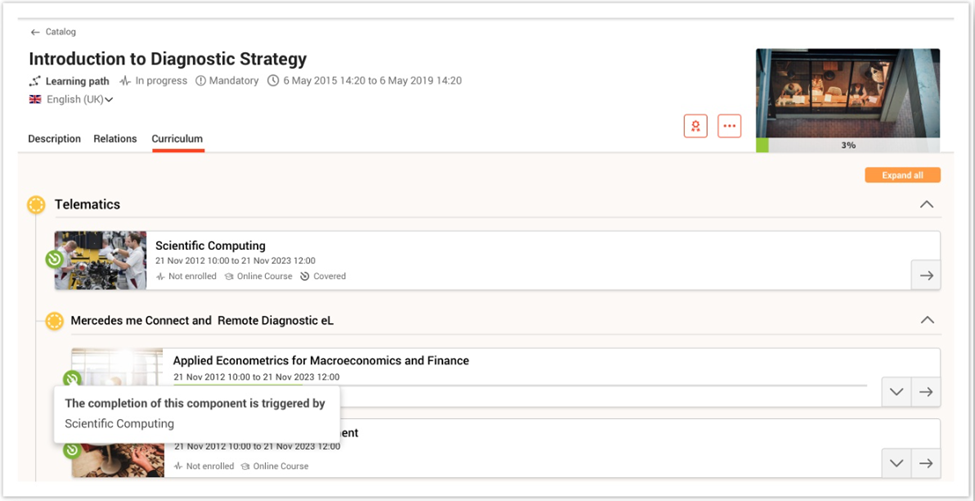
The outcome is also that the "Covered" component will count towards the progress, even if it is not completed by the learner.
Impact on Learning Logic
Within a learning path, component A (for example, a course template) is initially locked by the system’s learning logic. Component B has an established equivalence rule that, upon completion, triggers the completion of component A.
When the learner completes component B, the equivalence rule is applied, and component A is automatically marked as covered. Following this update, component A, which was previously locked, becomes available (unlocked).
Component A no longer appears as locked once its completion is triggered through the equivalence with component B.
Prerequisite Handling
When courses/clusters or course templates are available as prerequisites for other courses or learning paths, the prerequisite object will be considered fulfilled if the user has this object covered.
There is no visual distinction on the prerequisite overlay screen indicating that the object is only covered and not fully completed. The prerequisite which is covered will be displayed as fulfilled.
Equivalences Behavior for Courses and Course Templates
A covered Course template has as effect that all courses created from any version of the template are set to covered as well. It will not be possible to define different coverage rules for different versions of the course template.
When a specific course is covered based on a rule, that course will be set to "Covered" if the other conditions apply, but it will not have as effect the propagation of coverage to the template or the other courses created from the same template.