
“Channel manager” is intended for anyone wishing to create and edit channels, add content, and manage the respective access rights.
Search
The search function allows course names and keywords to be searched. The corresponding search term is
Create
The header contains the create icon, which is used to add new channels.
Language
The default language of a newly created channel corresponds to the platform language that is active at the time of creation. If the platform language changes between the creation of two channels, the default language of each channel reflects the platform language that was active when it was created.
The languages displayed in the lower translations area are determined by the platform’s configured languages.
Content added to a channel is based on the execution language.
In summary:
-
Channel level = platform language
-
Channel content = execution language
If a subset of the languages available in the system has been created in the client, only those languages are taken into account.
Channel details
The following information can be entered for a
-
Name
-
Description
-
The description entered in this field is displayed at the bottom of the channel page. Its position is defined by the design and cannot be modified. The description is also accessible through the About tab.
-
-
Keywords
-
Keywords are used to better identify a channel, particularly when multiple channels have the same or similar names. They are displayed in the table within the Channel Manager and support locating a specific channel in the list.
-
-
Preview image
Furthermore, two configuration options are available:
-
Media rating
-
This setting defines, for each channel, whether rating the channel’s content is permitted.
-
-
Publication
-
This setting determines whether the channel is already published or not. It can also be modified in the channel overview table. It is possible to publish a channel while granting visibility only to oneself, for example, to review the learner’s view. However, this can also be done using the preview function.
-
Table View
Channels are administered in a table view that provides a range of different functionalities.
Channel Selection
One checkbox is available per tile, with another in the table header. A single Channel or several Channels can be selected at the same time. Only deletion is available here. If the checkbox in the table header is selected, all channels on the current page are selected and can be deleted at once.
💡 The main actions become visible when hovering over the tiles.
Publication
In the column “published”, it is defined whether the channel is public. The unpublished status makes it possible to work on the Channel without making the Channel visible to anyone.
Sorting Columns
All columns are sortable in alphabetical order except “last updated by” and “created by”.
The Channel “container” consists of:
-
Title
-
Description
-
Preview image
-
The recommended resolution
-
For all images in general: 1024x580 px with 16:9 aspect ratio
-
Channel images have an effective size of 406.664 px × 228.719 px in the grid view of the tiles.
-
-
The default images can be changed from the design folder (client design)
-
-
Toggle for “Published”
-
Toggle for “Media rating”
-
Keyword
-
Translations
-
Channels are based on platform languages; therefore, all languages configured for the system can be selected here.
-
Languages that are not manually added here are not displayed to the Channel user. The same applies to languages that are added but not filled in.
-
Manage Content
The primary action here is to add content to the channel. However, topic-related trainings can also be added; these refer to courses or learning paths (and their templates) related to the topic and invite further learning.
Media
Search
The search function allows media names and keywords to be searched. The corresponding search term is highlighted in colour in the table.
Checkbox
One checkbox is available per tile, with another in the table header. A single Channel or several Channels can be selected at the same time. Only deletion is available here. If the checkbox in the table header is selected, all channels on the current page are selected and can be deleted at once.
Drag & Drop
Sections and learning content can be added. Using the drag & drop function, content can be moved into the sections or from the sections into the upper area without sections. The order of the content itself cannot be rearranged with this functionality. For this reason, this function is only available for media, but not for topic-related trainings.
Add Media
With the “add media” function, learning content from the media manager can be added to the channel.
Supported Media Types
-
3rd party content
-
Activity
-
File
-
Link
-
LTI 1.1
-
LTI 1.3
-
Multimedia
If the meta tags “Upload” and “Link” are configured via the media type, the meta tags are checked in the following order, independent of the configured positioning of the meta tag:
1 Uploaded video HD
2 Uploaded video
3 Link HD
4 Link
The first completed field is shown to the learner. For example, if “Uploaded video in HD” and “Link HD” are available, “Uploaded video in HD” is displayed.
-
WBT
-
WBT SCORM (without progress tracking)
More specific information for the media types:
-
Recommended resolution for media preview images: effective size on the grid view of the tiles (My feed tab) is 300px x 168.727px
-
Information on the media card
-
Duration in minutes (Meta tag 12071 has to be added to the media type)
-
File size (visibility in media type has to be set to enabled)
-
Filters
-
Language (Languages are displayed based on the language configuration in the configuration manager)
-
Media type
-
Author
Recommended resolution for media preview images
-
effective size on the grid view of the tiles (My feed tab) is 300px x 168.727px
Add New Section
To subdivide the channel more effectively, so-called sections can be added to simplify organisation according to certain topics, for example. When hovering over a section, the actions edit, add content, and delete become visible.
Sorting
Manual sorting of content is not possible because the order is fixed and predefined. However, content from the general section can be moved to specific sections using drag-and-drop functionality.
Sorting is based on the date on which content was added to the channel. If multiple items are added simultaneously, their order relative to one another is random. When content is moved into or out of a section, it loses its original position and is treated as if it were newly added. The display in the learner area is described here.
Final sorting is visible after saving.
Published
Channel content can be scheduled. For example, if an editorial plan is in place for the channels, content that has already been created can be added, and a date can be specified from which the content should be visible only to channel users.
Topic-Related Trainings
Search
The search function allows courses, course templates, learning paths, learning path templates, and keywords to be searched. The corresponding search term is highlighted in colour in the table.
Checkbox
There is one checkbox per tile available and a further one at the table header. It is possible to select a single training or several at the same time. Only deletion is available here. If the checkbox at the table header is selected, all trainings on the current page are selected and can be deleted at once.
Add ( + )
With this function, topic-related courses, course templates, learning paths, and learning path templates can be added. They are shown below the channel content. The channel user sees only the tags “course” and “learning path”; the word template is not included.
Users will only see instances they have view rights to.
Filters
-
Language (Languages are displayed based on the language configuration in the configuration manager)
-
Type
-
Author
Promotion of Channels in Courses and Learning Paths
Related channels can be displayed on the description page of courses, learning paths, and their templates and vice versa.
To do this, meta tag 11840 must first be added to each course, learning path, or template that is to be displayed. View rights to both the channel and the course, learning path, or their templates are also required.
If these preconditions are met, the channel is displayed in the instance added in topic-related trainings.
Preview
The preview allows administrators to see how the channel and its content are displayed to channel users. Topic-related trainings cannot be opened in the preview.
Edit
This function can be used to change the channel metadata. This affects all fields introduced when creating a new channel, for example, adding further languages or enabling/disabling rating.
Duplicate
Clearances
The visibility of a channel and its contents for a user depends on the clearance of the channel. A user must have at least the “View” right to see the channel. All media assigned to the channel are directly visible without checking additional media rights.
To use the “Easy media upload”, edit rights for a channel must be applied to make the edit functionality available in the “Channel contents” navigation item.
Subscriptions and Access
A user only counts as a subscriber while the user currently has access to the channel. This applies to all subscriptions, regardless of whether they were created manually or through automatic subscription, and works the same way for individual, group, and client-wide assignments.
Removal of Subscriptions
-
When a user loses the last remaining access path to a channel, the subscription is removed automatically.
-
If at least one other access path is still active, the subscription stays.
-
Subscription counts on channel cards and reporting data only include users who currently have access.
Restoration of Subscriptions
-
A removed subscription is restored automatically only if the exact same access path that was removed is added back.
-
If access comes back through a different access path, the subscription is not restored. The user has to resubscribe manually.
-
If a user manually unsubscribed from a channel, the subscription is never restored automatically.
-
If the subscription was never removed because another access path was still active, no restoration takes place.
Common reasons for temporary access loss are user deactivation, sabbatical, parental leave, or team changes.
Examples
|
Situation |
Result |
|---|---|
|
Access only through Business Group A; the user is removed from Group A |
Subscription is removed |
|
Access through Business Group A and B; the user is removed from Group A |
Subscription stays (access through Group B) |
|
Access through Business Group A and as an individual user; the user is deactivated |
Subscription is removed (both access paths lost) |
|
Subscription was removed after removal from Group A; the user is added back to Group A |
Subscription is restored |
|
Subscription was removed after removal from Group A; the user later joins Group C, which also has access |
Subscription is not restored; manual resubscription required |
|
Subscription was removed after deactivation; the user is reactivated and both access paths return |
Subscription is restored |
|
The user manually unsubscribed; the user is later removed from Group A and added back |
Subscription is not restored |
Existing Subscription Data
Existing subscription data is corrected automatically. Any user who currently has a subscription to a channel without having access to it is unsubscribed. Both past and future data are considered.
Automatic Subscription
If the slider is set to “On”, this user, group or client is taken into account for automatic subscription. There are a few notes to consider:
-
Users can cancel their subscription, but it is not possible to automatically re-subscribe these users.
-
If a group has been added for automatic subscription and new users are added to this group later on, these users will also be subscribed subsequently.
-
Setting the slider to “Off” for users/groups/clients (after having them added initially) does not result in the subscription being removed, as long as the clearance remains. If the user/group/client is removed from the clearance entirely and this was the user's last access path, the subscription is removed.
-
Users who have already a subscription for that channel or are not in any of the groups added to this automatic subscription functionality will not be affected by this.
-
If the channel was not yet published but will be published at some point in time, then the users/groups/clients will be automatically subscribed.
-
If users are removed from a group/client, the subscription only remains if the user still has at least one other access path to the channel. If this was the last access path, the subscription is removed.
-
Automatically created subscriptions follow the same removal and restoration rules as all other subscriptions (see Subscriptions and access).
Edit Notifications
In addition, the decision whether subscribers should be notified about changes can be made per Channel. A new option, “edit notifications”, is available per Channel.
-
Media update of a subscribed channel
-
New media for subscribed channel
-
Automatic subscription for a channel
For each of these notifications, it can be decided whether subscribers should receive a notification. The default value (active or inactive) is taken from the notification manager. The values can be overwritten per channel.
This setting only tells the notification manager whether it may send a notification or not, as soon as the toggle is set from false to true, the notification manager receives the information that it is allowed to send the notifications as configured.
Manage Reviews
The Review Manager provides an overview of all ratings and comments submitted by users for content items within a channel. It is accessible via the ⋮ menu on any channel row. The menu is available to anyone with the manage reviews authorization.
Overview List
The Review Manager lists all content items that have received at least one rating or comment. The following information is displayed per item:
|
Column |
Description |
|---|---|
|
Image |
Thumbnail of the content item |
|
Name |
Title of the content item |
|
ID |
Internal ID of the content item |
|
Version |
Current version of the content item |
|
Type |
Content type (e.g. Multimedia file, Course) |
|
Rating |
Average star rating and total number of ratings |
|
Comments |
Number of comments submitted for this item |
Selecting the comment icon on a row opens the detail panel for that content item.
Comment Moderation
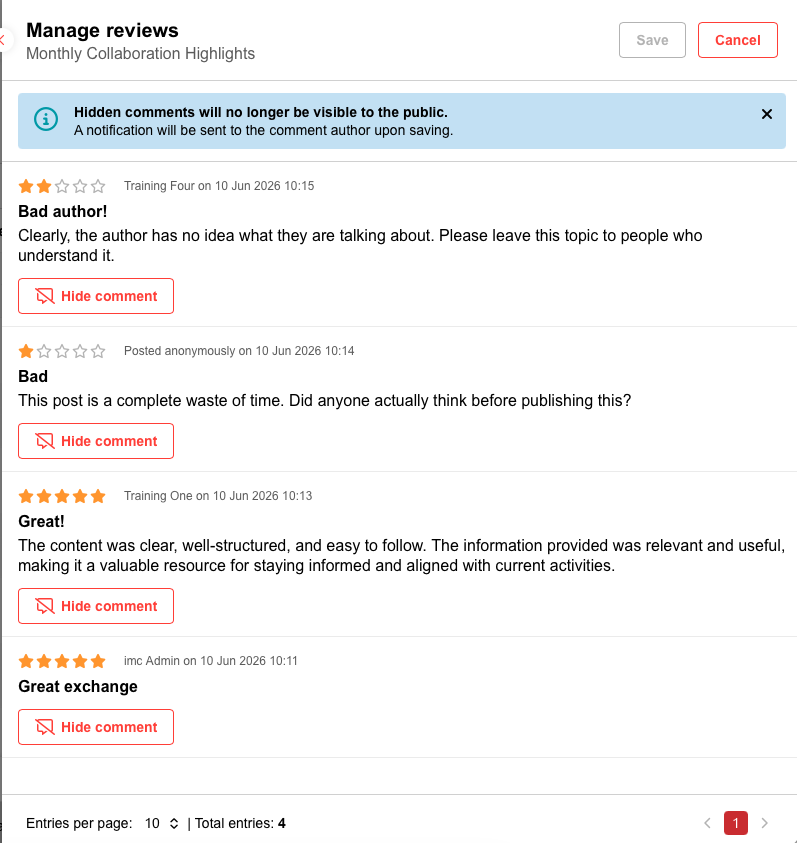
The detail panel shows all comments for the selected content item, including the author's name, submission date, star rating, and comment text.
Individual comments can be hidden from public view using the Hide comment action. Hidden comments are no longer visible to other users in the channel. The comment text is removed, while the star rating remains unchanged.
Comment Moderation with AI
When AI Review Moderation is enabled for a channel, the Review Manager is extended with additional functionality to support prioritisation of moderation work.
Comments are automatically assessed by an AI model when they are submitted. Comments identified as potentially violating netiquette are flagged with a "To be reviewed" badge in the detail panel. For these comments, administrators see two actions:
|
Action |
Description |
|---|---|
|
Hide comment |
The administrator agrees with the AI assessment. The comment is hidden from public view and the comment author receives a notification. |
|
Keep comment |
The administrator disagrees with the AI assessment. The comment is considered acceptable and remains visible to users. |
Comments remain visible to all users until an administrator explicitly hides them. No comment is hidden automatically.
The AI evaluates comments based on the moderation rules defined in the Prompt and Guardrails fields in the Configuration Manager - Channels The AI does not block or delete comments — it assists administrators in identifying potentially problematic content.
Blocked Words List
The Blocked Words field allows you to define words or phrases that are flagged automatically when found in a comment — without the comment being sent to the AI for assessment. A comment containing any of the listed terms is flagged immediately, regardless of context, and the AI assessment is skipped entirely for that comment. If no match is found, the comment proceeds to AI assessment as normal.
This makes the Blocked Words field the appropriate tool for terms that are always unacceptable, such as profanity, slurs, or other explicit language. Because the check happens before AI processing, it acts as a fast and reliable safety net for clear-cut cases.
Entries are provided as a comma-separated list, for example: word1, word2, word3. Terms in different languages are supported.
Blocked words list vs. Guardrails
|
|
Blocked words list |
Guardrails |
|---|---|---|
|
How it works |
Exact match — no context |
AI assessment — with context |
|
Best for |
Terms that are always unacceptable (e.g. profanity, slurs) |
Platform-specific policies, context-dependent rules |
|
AI involvement |
None — flagged before AI check |
Yes — evaluated by the AI |
Scheduled Job
In order to have the comments checked by AI, the following job needs to be set up:
Processor Name: de.imc.clix.comp.channels.job.ChannelMediaAICommentModerationJobT
Triggers the AI-based moderation review of newly submitted channel comments to detect inappropriate or netiquette-violating content. Flagged comments are highlighted in the Review Manager for administrators to review. The job is configured to run nightly by default.
This job requires AI Review Moderation to be enabled in the https://doc-en.scheer-imc.com/FuncRef/configuration-manager-channels and a corresponding deployment configuration. If the deployment has not been set up, the job will have no effect.
General Note
This feature requires a specific deployment configuration. If it has not been set up for the environment, enabling the setting in the Configuration Manager will have no effect. The feature must be enabled by Scheer IMC. Comment content is processed at the time of submission solely for the purpose of moderation assessment. The comment text is not stored or retained by the AI model or the Ollama service. Only the moderation result — whether the comment was identified as a potential violation — is stored within the imc Learning Suite. No metrics or usage data are collected or logged.
AI-enhanced Channel Comment Moderation
_____________________
The Hide comment action is available for all comments, regardless of whether they have been flagged via AI. When a comment is hidden, the comment author automatically receives notification (149) "A review comment has been removed" informing them of the removal. Note: Administrators are not notified when the AI flags a comment. The Review Manager must be checked regularly to identify flagged content.
Notification
Review comment has been removed
Sent to the author of a comment that has been removed by the moderation team due to a policy violation.
The notification informs the user that the text of their comment was found to be inappropriate and has therefore been removed, while the star rating remains unchanged. It includes the removed comment text and the community guidelines for reference.
To set up the notification, the email body should contain the following elements:
-
A personalised salutation using
$user_name$ -
An explanation that the comment was removed due to a policy violation and that the star rating remains visible
-
The removed comment text, displayed in a visually distinct block using
$removed_comment$ -
The preview image of the affected media item using
$media_image$ -
The community guidelines as a formatted reference block
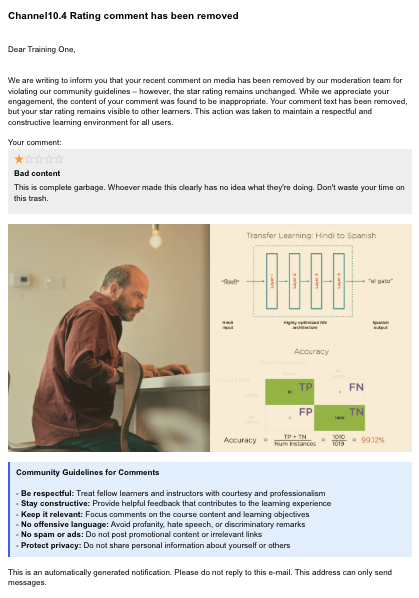
This notification is triggered when an administrator hides a comment in the Review Manager.
A review comment was flagged by AI for comment moderation
Channel administrators are notified when the AI moderation system flags a comment as offensive. The notification supports the placeholder Direct link to manage reviews ($channel_review_url$). If the placeholder is included in the notification, the link leads directly to Manage Reviews in the respective channel. If multiple comments are flagged, the notification can contain multiple links.
Example text
Dear $user_name$,
a comment submitted in the channel(s) has been flagged by the AI moderation system as potentially violating the community guidelines and requires attention in the Review Manager.
$channel_review_url$
Further Functions
Reporting
Channel Media Consumption Report
Dashboard Panels
Two different panels can be created for the channels:
-
One panel lists all new content of the subscribed channels
-
The other panel allows quick access to all subscribed channels