Certifications in the LMS represent accredited training credentials (e.g. CPE/CPD, IDD), for which learners must accumulate a defined number of points or hours within a specified period. Unlike a one-off qualification, certification is linked to a recurring assessment period and is therefore the key tool for providing evidence of continuing professional development required by law or within a particular sector.
Sectors and industries for which certification is required
|
Sector |
Specific example |
|---|---|
|
Healthcare |
Doctors: proof of CME credits (Section 95d of Book V of the Social Code); nursing staff: compulsory annual training (hygiene, resuscitation) |
|
Insurance |
Insurance brokers: Proof of competence in accordance with the IDD (Section 34d of the Trade Regulation Act), 15 hours per year |
|
Financial services |
Investment advisers: MiFID II / WpHG competence examination, at least 15 hours per year |
|
Aviation |
Pilots/air traffic controllers: Recurring type rating certificates |
|
IT/Tech |
Cloud architects: AWS/Azure recertification credits |
|
Law |
Specialist solicitors: 10 hours per year of continuing professional development per specialism (Section 15 FAO) |
|
Transport/Logistics |
Professional drivers: 35 hours every 5 years (BKrFQG) |
Typical intervals
-
Annually: Insurance intermediaries (IDD), financial advisers (WpHG), nursing staff, specialist solicitors
-
Every 2 years: Food hygiene, resuscitation training (BLS/ALS)
-
Every 3 years: IT certificates (e.g. AWS recertification)
-
Every 3–5 years: Professional driver qualification, specialist medical certificates
Objectives and benefits of certification
Up-to-date knowledge and compliance
Objective: to ensure that employees consistently meet legal and regulatory requirements (BaFin, MDK, IHK).
Benefit: complete, automatically verifiable records instead of manual Excel lists.
Professional credibility and career opportunities
Objective: to provide external proof of professional competence (e.g. to regulatory authorities, customers).
Benefit: certificate status as a distinguishing feature, linked to skill and job profiles (separate licence)
Security and mitigation of legal and operational risks
Objective: To avoid fines, bans on practising or liability risks in the event of expired certificates. Benefit: Automatic suspension/escalation upon expiry, rather than retrospective discovery during an audit.
Promoting lifelong learning and adaptability in dynamic sectors
Objective: To establish continuous professional development rather than one-off training.
Advantage: A points/hours system encourages regular, spread-out learning rather than last-minute catch-up.
Use Cases
-
Doctor earns CME credits: Is awarded 250 continuing professional development credits over 5 years from various Courses; the ‘Certifications’ panel shows progress; a warning is displayed before the end of the period if the requirement is not met.
-
Nurse completes compulsory annual continuing professional development: Certification covering a 12-month period, ‘hours’ format, reset ‘always’ on the 1st of a fixed month (general start date) — for audit verification vis-à-vis the MDK.
-
Insurance intermediary fulfils IDD competence requirements: Certification with a minimum requirement of 15 hours per year, individual start date from the time of allocation, grace period for providing evidence of hours missed at short notice.
-
Financial advisers complete WpHG continuing professional development: Certification set with a minimum number of points across several subject categories (e.g. investment law, anti-money laundering) — complex scenario with multiple sub-requirements.
-
IT security officer keeps ISO 27001 competence up to date: Linking of multiple learning pathways with points awarded, reporting on “certification status” for internal audits.
Module & Prerequisites
Certification management is handled via the optional add-on “Certification Management” — not included in the core licence scope; must be licensed separately. Core concept: Certifications can be bundled into certification sets; certifications are assigned to users and linked to training content.
Steps for setting up certification
-
Activate the licence so that certification can be used
-
Set up the navigation items “Certification” and “Certification Sets”
-
Activate the cron job “Reset certification”.
Steps for assigning certifications to users
-
(only active certifications can be selected system-wide)
-
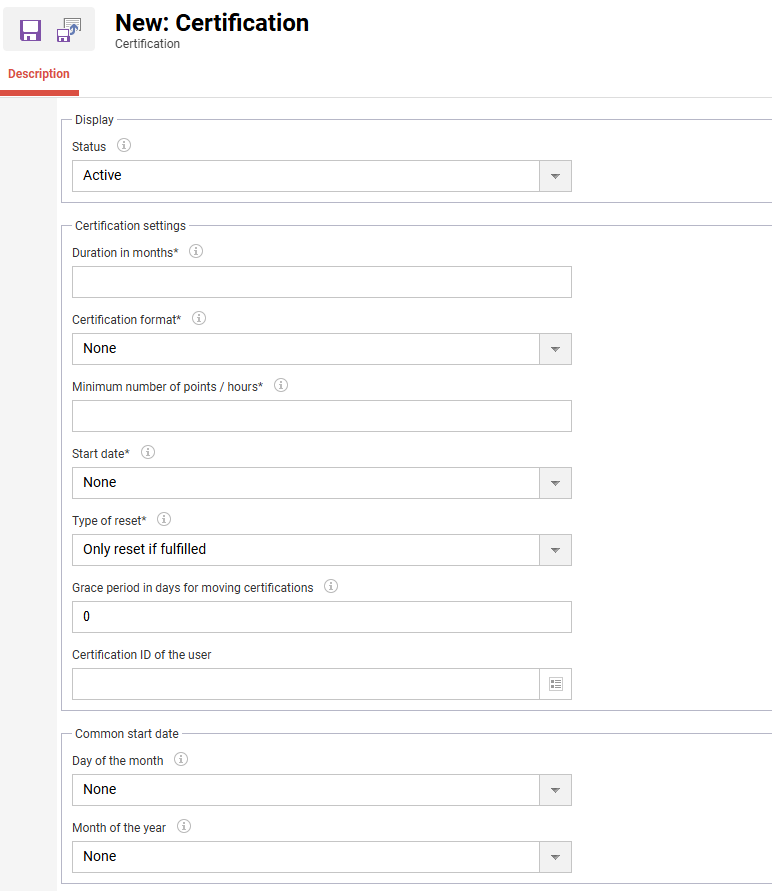
Define the period in months (e.g. 12 months from assignment)
-
Select format: points or hours, including minimum requirement (e.g. “15 hours”)
-
Set start date mode: individual (from assignment) or general (fixed day/month for all)
-
Specify reset type: do not reset / always / only when met
-
Define grace period in days (can only be changed upon creation — not retrospectively)
-
Tick the warning box for unmet requirements in previous periods
-
If there are multiple subject categories: configure a certification set instead of individual certifications